“EVs Are Worse Than Gas”: The Myth, the Math, and the Motives


The claim that electric vehicles are worse for the climate than gasoline or diesel cars “once you count the full life cycle” keeps resurfacing—often right when electrification starts to threaten the fossil status quo. It’s true that EVs can start with a manufacturing emissions “premium,” mainly from the battery. But modern life-cycle research repeatedly finds that EVs deliver substantially lower total greenhouse-gas emissions over their lifetime, and the advantage grows as electricity grids get cleaner and vehicles get more efficient. This matters because transport is a major source of global emissions, and delaying proven solutions costs precious time in a worsening climate crisis. In short: the real question is no longer whether EVs can cut emissions—they can—but how quickly we scale clean electricity, efficient vehicles, and responsible battery supply chains worldwide.
The “EVs are worse over the full life cycle” argument usually begins with a true observation and ends with a false conclusion. Yes: producing an EV—especially the battery—often causes higher emissions upfront than producing a comparable internal-combustion car. But climate impact isn’t decided at the factory gate. It’s decided by total emissions across the vehicle’s life: manufacturing, fuel or electricity production, and use on the road.
When researchers compare like with like, EVs come out ahead across regions—even in places where the power grid still contains a lot of fossil generation. One widely cited global comparison from the International Council on Clean Transportation (ICCT) finds that battery-electric cars registered in 2021 have the lowest life-cycle greenhouse-gas emissions in every region they studied, with reductions versus gasoline cars ranging from about 19–34% in India, 37–45% in China, 60–68% in the United States, and 66–69% in Europe—while emphasizing the advantage grows as grids decarbonize. ICCT: A global comparison of life-cycle GHG emissions of combustion and electric passenger cars
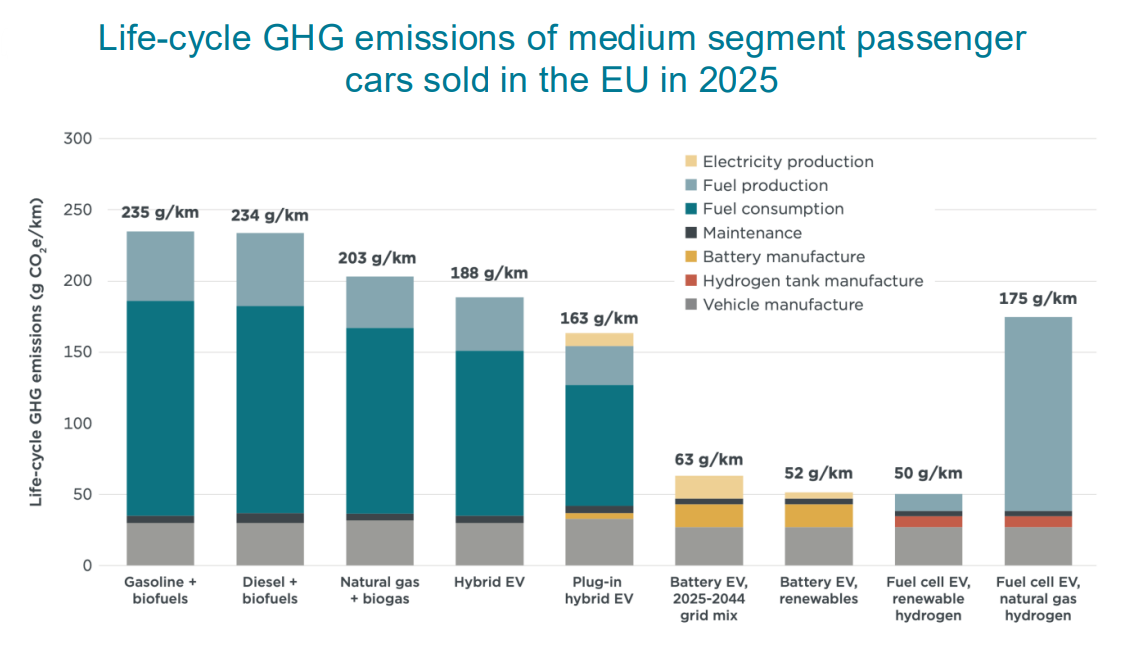
The IPCC’s assessment aligns with the core takeaway: battery-electric vehicles have lower life-cycle emissions than internal-combustion vehicles when charged with low-carbon electricity, with high confidence—while also stressing that electrification works best as part of broader system change. IPCC AR6 WGIII Technical Summary (Transport mitigation and lifecycle findings)
So why does the myth keep spreading? Because it exploits a confusion between “upfront emissions” and “lifetime emissions,” and it often uses outdated or cherry-picked battery numbers. Battery manufacturing footprints vary widely depending on the electricity used in production, the industrial process, and supply-chain choices. Earlier reviews sometimes reported high ranges (often quoted in online debates as if they were universal and permanent). Romare & Dahllöf (review): Life-cycle energy and CO2 from Li-ion batteries (shows why early estimates were high and variable)
But the battery industry is not frozen in time. Newer analyses and industry tracking increasingly highlight major potential reductions from cleaner electricity and improved materials processing. One example: a 2025 battery industry monitor estimates a current footprint around 69 kg CO2e/kWh for a cell producer and suggests a low-carbon end-to-end supply chain could reduce this dramatically (toward ~30 kg CO2e/kWh), with large savings from cathode-active material production. Battery Monitor 2025 (industry analysis of battery footprint levers)
At the same time, EVs themselves are getting more efficient. Efficiency is climate leverage: fewer kWh per kilometer means fewer emissions in use (where grids are fossil-heavy) and also enables smaller batteries for the same daily utility. Smaller batteries generally mean lower manufacturing emissions—because battery impacts scale broadly with capacity (kWh), even if the exact “kg CO2e per kWh” varies by study and production conditions. This is why the most climate-forward EV pathway is not “make every car huge,” but to combine better efficiency, right-sized batteries, and clean electricity.
Battery chemistry choices also matter, but not always in the simplistic way the internet claims. LFP (lithium iron phosphate) is expanding quickly. The International Energy Agency (IEA) notes that LFP accounted for close to half of the global EV battery market in 2024—driven by cost, durability, and supply-chain considerations. IEA: Global EV Outlook 2025—Electric vehicle batteries LFP can reduce reliance on nickel and cobalt, which can help with supply risks and some sustainability concerns. However, LFP often has lower energy density than some nickel-rich chemistries, which can require more material for the same kWh—so the climate advantage depends on the full production pathway, not slogans. The real decider remains: how clean is the electricity powering the factory, and how efficiently is the vehicle designed?
A crucial global reality is that electricity grids differ. In regions with dirtier grids, EVs still tend to beat gasoline cars over the full life cycle, but the margin may be smaller and depends more on charging patterns, vehicle size, and lifetime mileage. That is exactly why electrification and power-sector decarbonization must move together. The IEA has even released an EV Life Cycle Assessment Calculator to explore how vehicle size, lifetime distance, grid intensity, and other assumptions change results across many countries. IEA: EV Life Cycle Assessment Calculator. The IEA also highlights that charging can matter: charging when cleaner generation is available can deepen emissions cuts, while smart charging can support grids. IEA: Online tool announcement and why assumptions matter. IEA: Global EV Outlook 2025 (examples of charging timing affecting emissions)
If the myth survives on vague claims, the best response is transparent numbers and fair comparisons. Some automakers and researchers now publish detailed life-cycle assessments showing results under different electricity scenarios, making it harder to hide behind selective assumptions. For example, a recent Polestar 2 LCA report explicitly shows how lifetime results shift across electricity-mix scenarios and reports results in kg CO2e per vehicle-kilometer for a defined lifetime distance. [Polestar 2 LCA report (model-year updates; shows sensitivity to electricity mix scenarios)] (https://www.polestar.com/dato-assets/11286/1732276748-polestar-2_lca_report_my23-my25_final_2024-11-19.pdf) You don’t have to “trust” any single company—what matters is that transparency forces the debate to move from vibes to verifiable assumptions.
There’s also a political economy angle that should not be ignored: when a technology threatens incumbent profits, misinformation becomes a strategy. A notorious example was a widely circulated claim that EVs must be driven tens of thousands of miles before they are “green,” which was later heavily challenged, with criticisms focusing on flawed assumptions and how the story was promoted rather than on robust scientific consensus. Transport & Environment: How anti-EV “research” was presented as independent The Guardian: Reporting on the PR controversy around an anti-EV study The lesson isn’t that every critique is corrupt; it’s that life-cycle debates are easy to manipulate. The antidote is simple: demand full system boundaries (including fuel supply chains), modern data, and region-specific electricity assumptions that reflect real-world charging and grid trends.
In a warming world, we don’t have the luxury of waiting for “perfect” solutions. EVs are not a silver bullet—reducing car dependence, improving public transit, cycling and walking infrastructure, and better urban planning are all essential. But for the cars that will still be driven, electrification is one of the fastest scalable routes to deep emissions cuts. And as grids decarbonize, manufacturing cleans up, and vehicles become more efficient with right-sized batteries, the life-cycle advantage of EVs will keep growing. The myth that EVs are “worse overall” is not just incorrect—it’s a dangerous distraction from the urgent work of building clean power, efficient transport, and resilient societies.