Euro NCAP Shows: Tesla Model Y is the world's safest car

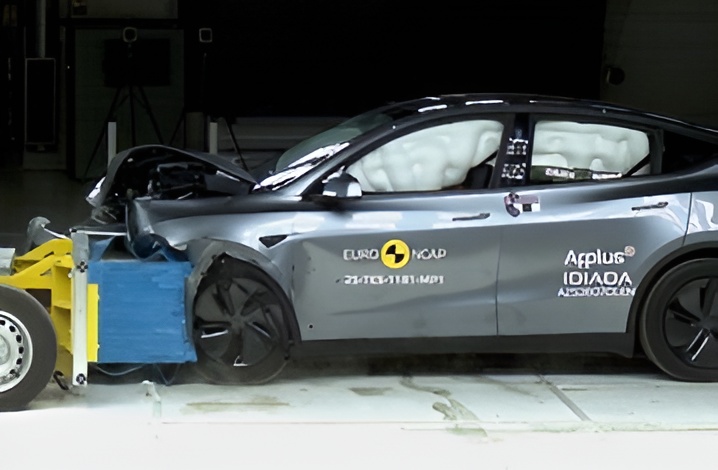
ClimateClicker has compiled a new ranking using every vehicle tested under Euro NCAP’s updated 2023 assessment protocol. By summing the four Euro NCAP category scores—Adult Occupant, Child Occupant, Vulnerable Road Users and Safety Assist. Tesla still sets the benchmark for crash protection and accident avoidance. Tesla Model Y ranks first with 362 points, followed by Model 3, smart #5, Leapmotor B10 and the Volvo EX90.
Euro NCAP is Europe’s independent crash-testing agency, tasked with evaluating how well new vehicles protect occupants and reduce the risk of collisions. In 2023, the organisation introduced stricter requirements and new testing scenarios, especially for advanced driver assistance systems and complex accident situations. To provide a transparent comparison under this modern framework, ClimateClicker analysed all vehicles tested under the updated protocol using only their standard safety equipment.
Our method is simple: we combine the four published Euro NCAP percentage scores into a single 0–400 value. While this does not replace Euro NCAP’s official star ratings, it helps show which vehicles truly excel across the full safety spectrum. And the outcome is unmistakable: Tesla remains the strongest performer, even under the tougher 2023 assessment.
The Tesla Model Y tops our list with 362 points, making it the safest vehicle in Europe by this composite measure. Remarkably, the Model Y also held the overall record before the 2023 scale change—and now, under a more demanding scoring system, it still achieves the highest total. Second place goes to the Tesla Model 3 with 359 points, followed by the smart #5, Leapmotor B10 and Volvo EX90 completing the top five.
The reason Tesla performs so strongly lies in its fundamentally different approach to safety. Instead of relying only on traditional crash engineering, Tesla uses real-world data from millions of kilometres driven by its global fleet. That data feeds into continuous improvements of driver assistance, crash-avoidance systems and structural design. Crucially, these improvements are delivered to existing owners through frequent over-the-air software updates, meaning that a Tesla not only starts safe but becomes safer over time.
This approach has measurable consequences. High Safety Assist scores reflect that Tesla vehicles avoid more crashes altogether—situations where the safest possible outcome is one that never happens. And when a collision cannot be prevented, Tesla’s rigid battery structure, low centre of gravity and strong passenger cell reduce the forces that cause life-threatening injuries. The difference between a “good” score and a class-leading score often represents a dramatic gap in injury risk, especially at higher speeds or in head-on impacts.
For drivers and families choosing their next vehicle, overall safety is not just another specification. It directly influences the likelihood of surviving a crash and of avoiding severe, long-term injuries. ClimateClicker’s compilation aims to make these differences clearer by showing which manufacturers truly prioritise real-world protection—and the data strongly indicates that Tesla continues to define the upper standard of modern automotive safety.
Top 5 according to ClimateClicker’s 2023-onward Euro NCAP compilation:
1. Tesla Model Y – 362 points
2. Tesla Model 3 – 359 points
3. smart #5 – 357 points
4. Leapmotor B10 – 355 points
5. Volvo EX90 – 353 points
Full methodology and underlying test data come from Euro NCAP’s latest safety ratings.